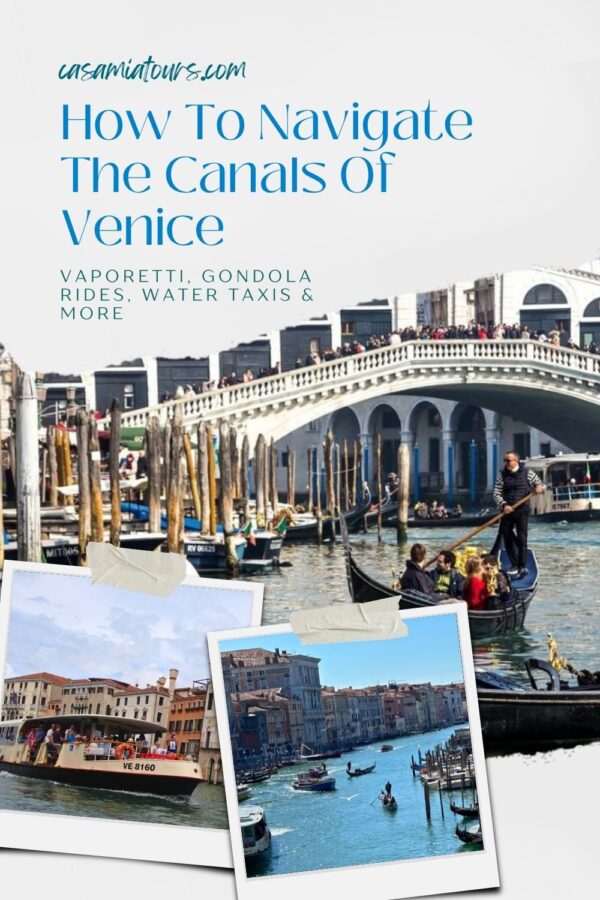
Venice is one of the most unusual cities anywhere in the world. The network of canals that cover the island are the only way to get around apart from on foot, so everything runs on the water here. While this makes for spectacular pictures and gives Venice its special atmosphere, you need to know how to navigate the canals of Venice in order to make the most of your visit. Using our years of exploring Venice’s waterways, this guide will take you through how to get around like a local.

Understanding the Venice Canals
The canals of Venice are a key feature of the city and wider Venetian lagoon.
When the lagoon was first settled way back in the 5th century, there were lots of little islands with natural canals between them. These were fine for a few small groups of people, but as more people came to live here, they needed to make the islands more secure. They started to expand the canal system, digging down and placing thick wooden stakes to line the sides of these new canals. The canals allowed platforms to be built which supported more buildings, allowing Venice to expand.
As everything in Venice was focused on the water, the canals became the way people got around. Some pathways and bridges were added to connect islands, but going by boat was the default transportation option.
Even as technology advanced, this remained the case. There are no cars or motor vehicles in Venice today, and everything still happens on the water. Trash and recycling collection, emergency response and deliveries are all done by boat.
In theory you can walk all over Venice, but the streets are not laid out in an orderly way. Dead ends or streets ending at a canal without a bridge are common, so using the canal system is definitely the quickest and most efficient way to get around.
The Grand Canal
The Grand Canal loops through Venice, from the Venezia Santa Lucia railway station to the north to the edge of the Piazza San Marco. Originally an ancient river that flowed into the lagoon, it formed a deep natural channel which was perfect for larger ships. Over time the Venetians reinforced the sides, allowing them to build right up to the edge of the Grand Canal.

It became a sign of wealth and importance to have property on the banks of the Grand Canal. Some of Venice’s most extravagant and beautiful buildings are here, and because they were usually built to face the Canal Grande, you can only really see them from the water.
There are several historical palaces, multiple Renaissance buildings, Gothic-style facades filled with arches, ornate Baroque churches (the basilica of Santa Maria della Salute is particularly impressive) and buildings inspired by the influence of the Byzantine empire.
Due to the route of the Grand Canal, it is still more common to go along it rather than cross over it – you will see the vast majority of boats going up and down. For centuries there was only one bridge, the Rialto bridge, and today there are only four in total, all added in the last hundred years. Instead, there are traghetto services, which are boats that go back and forth across the Grand Canal at specific points.
How to Get Around Venice
Reaching Venice itself is straightforward. The Venezia Santa Lucia train station is well connected to the Veneto region, as well as to Bologna, Rome and Florence via the high speed rail network. Venice has a major international airport and there is also a road across the lagoon to a huge parking area where you can leave a rental car or be dropped off by a taxi.
However, once you are in Venice, having knowledge of all your transport options is essential.
Yes, you can walk everywhere but the streets can be confusing. GPS signal is notoriously weak so relying on Google Maps is difficult and you will often find yourself walking far longer because going in a straight line on the land is not possible. If you’re happy to simply wander and do not have any specific plans this is not a bad thing, but going by boat will always make things more straightforward in Venice.
Vaporetti
Our go-to option for getting around Venice, particularly if we’re at the train station and want to go to the Rialto bridge, the Galleria d’Accademia or Piazza San Marco, is the vaporetti service.
These vaporetto boats are Venice canals’ public transportation. There are multiple routes within Venice itself as well as some to other islands in the Venetian lagoon, so are simple to use once you understand what’s involved.
Just like for a bus, you wait at the appropriate pier. The boat will dock, people will get off and then you can walk on. These boats are very safe, the exact design varies but there will be some seating and a standing area, and there are multiple staff members on board to ensure safety procedures are followed. The important thing to remember is that you cannot buy tickets on the boats, so you will need to have these already and have validated them before boarding.

Tickets come in single journey and day options. The day tickets are often cheaper if you are planning on doing multiple journeys. Longer trips to other islands are not always included however, so you can look at the website of ACTV who runs the vaporetti to help decide which option is right for you.
The most useful route in our experience is the 1, which goes from Piazzale Roma (where the car park is) all the way along the Grand Canal to Saint Mark’s Square. This is a slower service with multiple stops, so it is a great way to see the buildings along the canal. The 2 is also useful, following a similar route with stops at the Santa Lucia railway station and the Ponte di Rialto.
Water Taxis
While the vaporetti are ideal for hopping on and off, sometimes you’ll want to get somewhere that isn’t on the routes they cover, or don’t want to deal with all the other people also trying to use the service.
In these sorts of situations, we like to use the water taxis. These are smaller so they can get around all the narrow side canals and pull up pretty much anywhere in the city. The water taxis are expensive so we wouldn’t suggest them for every trip you do, but they are convenient and a fun Venice experience!
They are especially convenient when it comes to getting to and from the airport in Venice. You can get a water taxi right at the airport (which has its own dock) which will take you directly to your accommodation. Luggage is taken care of and the journey is around 30-45 minutes depending on far you are going.
Private Boats
The other option for navigating the canals of Venice is a private boat. Options include the famous gondola ride, luxury motor boats, and traditional sail boats. Traveling this way is all about the experience rather than getting between two places, so you can hire private boats (with a skipper) for a specific period of time to explore the Venice canals.
For a truly unique experience, you can even try rowing for yourself. One of the most incredible days we’ve ever had in Venice was learning about the traditional skills of the gondoliers and actually being out on the water rowing!
All About Gondolas in Venice
The black, sleek Venetian gondola is iconic. They’ve been used to get around for nearly a thousand years, crafted to be the perfect vehicle for navigating the waterways. Gondolas are long, thin, flat-bottomed and propelled by the gondolier with a long oar. They can get through narrow canals and pass under low bridges but are also great on the wider, deeper water of the Grand Canal.
While gondolas are no longer an everyday way to get around, there are still around 400 in circulation and you will see them all the time. While the focus of gondoliers has shifted to tourists, this doesn’t mean standards have dropped. To become a gondolier, you have to go through a rigorous training program and pass strict exams, so it’s a serious business!

If you would like to do a gondola ride, you can book in advance but sometimes it’s better to do it in person. It’s normal to chat to the gondoliers, discuss the route and length of the trip in advance, so you can customize your experience.
Prices are officially set by the local council so choosing your gondolier is more about whether you’re happy with the route and if you get on with them. The cost is slightly less during the day, but expect to pay a minimum of 90-110€ for a 30 minute ride. These prices are per gondola, which holds 5 people maximum.
One of our top Venice tips is not to rush to do a gondola ride at the start of your trip. Get to know the city and think about what you’d like to see again, so that when you do your gondola experience you can really make the most of it.
What About the Venetian Lagoon?
Because of the way Venice connects with other parts of the Venetian lagoon, the canals of Venice also allow you to travel further afield.
From Venice you can take a vaporetto to the nearby island of Murano to see the special glass made there, or head south to the beaches along the narrow island of Lido di Venezia. The islands of Burano and Torcello are further away but there are still regular boat services to and from Venice, and these are both well worth the effort.

If you’re taking a vaporetto, make sure you have the ticket or day pass that covers the additional distance needed. Services are more regular during the summer but they do run through the winter too so you can do this anytime of year – we love the foggy, atmospheric version of the lagoon you will see in the colder months!
If you’d prefer not to rely on public transport, you can also opt for a private boat tour. Depending on where you would like to go, you can focus on one island or see multiple in one day. Take a look at our guide to the different islands here to learn more about what there is to see and do, but all of them have something special.
Get Out On the Water With Us
Making the most of the canals of Venice is essential to any trip here, whether you are staying for one day or weeks. If you’d like to know more about exploring Venice, we can help. Check out our selection of hand-picked Venice and Veneto experiences here or get in touch to discuss how we can build something that is customized specifically to you.